
Ticketing 2

Hen’s teeth. Screenshot from Jan 17, showing three (!) free places on the Milford. Ready, set, go!

Hen’s teeth. Screenshot from Jan 17, showing three (!) free places on the Milford. Ready, set, go!

Well, it turned out opodo had its disadvantages after all. As I suspected, there was no Rail&Fly for the return leg; half an hour of telephone queue was necessary to order one, with a special “late fee” added. All in all, R&F might have advantages for the traveller and the environment, but in practice it sucks massively, and a discounted train ticket for the journey to Frankfurt and an ordinary ticket for the return are not much more expensive. As some research on opodo’s booking system shows, R&F can be automatically booked for a “simple” return flight, but as soon as there is a leg outside Germany (as in a Y-flight), R&F is no longer available for subsequent legs, even if they do end here. Hey, no worries, the internet was only invented yesterday, right? Continue reading

What CHDK has done for me

After the serendipity of finding CHDK, I set to work on my projects. This is how they turned out.

Grid overlay. Easy, almost trivial to implement, but it’s a great help just having a couple of lines on the screen to check that your horizontal is what you think it is. Continue reading

Camera Extras

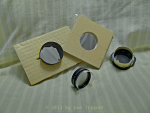
Back: two solar filters, one lens cap. Front: UV/pol filter

Youtube Video

With the camera now functioning like it cost ten times the price thanks to the possibilities of CHDK, it was time to look at a couple of hardware issues.

Filters. A polarisation filter is a major game-changer, as anyone wearing polarised sunglasses can tell, because it cuts down reflection from water and glassy surfaces and thus also the haze in the air that washes out detail at large distances. With a pol filter the sky is bluer, the grass is greener, and the hills are closer. Continue reading

Hacking the Canons: CHDK

CHDK logo by cosmograph

CHDK is a set of tools allowing the user full control over the operation of a large number of the cheaper Canon point&shoot cameras. After all, a camera nowadays is more that a box with a hole in it; everything is, of course, controlled by a microprocessor. With suitable access to the processor, the camera becomes like any other universal machine and can be programmed to do what you like with it. I can vividly remember my disappointment when I thought that I could use the time delay function for a sort of limited time lapse, and all the camera did was wait for the set time and take the ten shots in quick succession. If the camera can count to 30 once, why not continue the process. Continue reading

Searching for a Bracketing Camera

Fox Glacier. Bracket of 7 images from +1 to -1 EV in 1/3 steps.

Before it got all complicated, let’s just go back to the beginning: I wanted a camera that would automatically take exposure series (brackets) so that I could paste them together and achieve a result as good as or better than the eye can see. Without an automatic mechanism, I’d be stuck with taking one shot after another and having to wait for the camera to settle down between each shot. Continue reading

On the Fringe

Deck chair left and right: White stripes have a green fringe on the inside and purple on the outside due to chromatic aberration

Another problem that almost all lenses produce is chromatic aberration. Again van Walree has one of the better explanations. Whereas radial (barrel) distortion will interfere with panorama production because the images diverge very quickly from one another – thus making it necessary to have a sharp transition from one photograph to the next or risk having highly divergent control points, chromatic aberration will interfere with the identity of control points in highly contrasting areas. Consider the transition from white to black to white on the left hand side of an image: Continue reading

Kiwi II, 2009

Weka dietary education: Milford Track

The second journey in the late summer of 2009 started with my arrival in Auckland on Sunday, February 1. After picking up a small camper, a Toyota Lucinda, which was named “Juicy Lucy”, I visited my school friend Tom and his family, then it was by way of Kawhia to New Plymouth where I made my first attempt at climbing Egmont. A couple of nights at the old motorcamp in Stratford to discover the Forgotten World and make a second – still unsuccessful – attempt at Egmont from the south and then on to Wanganui and Waikanae to visit Don and Sally Matheson who were giving me their holiday house for a couple of days in March. Continue reading

Battle of the Bulge

Original. In particular, straight lines will be curved under distortion.

A common form of photographic distortion is barrel distortion and its counterpart pincushion. Straight lines such as architectural features become curved and this is distracting, not only for viewing buildings, but also in portraiture, where the barrel distortion will easily make you 5 or so kgs overweight. Photographers will compensate for this by using the zoom to reduce the amount of distortion (and this, as it turns out, is true, although not the whole story). Continue reading

Panoramas and an Unsuspected Solution

Canon provides its cameras with software that is intended to cause baldness. ZoomBrowser EX is an insidious piece of software that plays around with the EXIF data on the camera, and PhotoStitch will join up your panoramic images like magic. Yeah, right. And then another 19 (nineteen) programs (!) install themselves on your machine, none of which have any use whatsoever. Continue reading

Bracketing

A major drawback of digital photography, and one that I have been aware of all along, is the lack of dynamic range, the difference between how dark is going to finish up as black, and how light will result in pure white. The closer these two values are, the greater the contrast, but there will be no detail visible in light or dark sections. The eye and its brain have an extraordinary dynamic range which allows us to see details both in the very dark and the very bright at the same time. Continue reading